
A community that keeps women learning
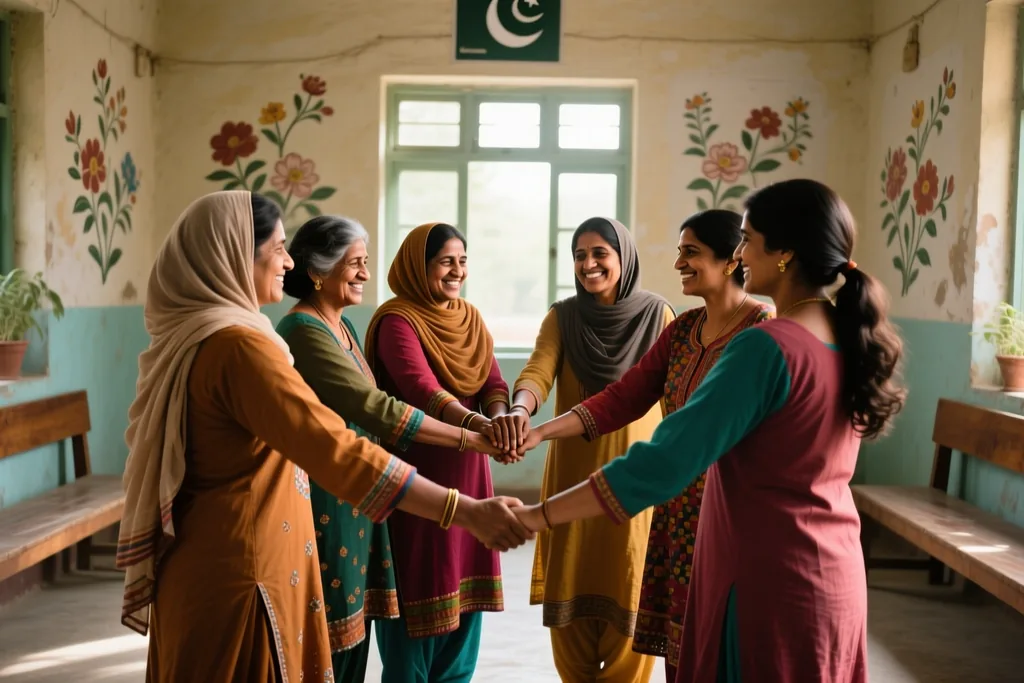
This is an illustrative account of the community that surrounds the program, rather than a record of particular individuals. It contains no statistics, because the program publishes only what it can verify. The subject is the support structure outside the classroom, which is frequently the reason a learner continues when the lessons alone would not be enough.
Learning is not a solitary activity
Education is often imagined as an individual effort: one person, one book, one exam. In reality, the people around a learner do as much work as the learner herself, by protecting time, offering explanations and noticing when something is wrong.

Where that surrounding support is missing, learners do not fail because they lack ability. They stop because they are carrying the whole effort alone.
The layers of support
Support within the program comes in several overlapping forms, and a learner rarely relies on only one. Each layer catches a problem the others might miss.
- Mentors, who provide continuity and honest perspective.
- Volunteers, who keep sessions running and learners practising.
- Fellow participants, who explain, encourage and normalise difficulty.
- Families, who make time available and take the plan seriously.
- Partners, who provide space, tools and further opportunities.
Why peers matter most
Of all these layers, peers often matter most, because they are solving the same problem at the same time. Advice from someone a step ahead is more usable than advice from someone far removed from the difficulty.
Peers also provide a form of encouragement that mentors cannot. Hearing a classmate admit that she found a topic hard removes the fear that the difficulty is personal, and that normalisation makes the next attempt easier.
The family dimension
For many participants, the household is the most important support structure and the hardest to organise. A family that understands the goal is far more willing to protect the study time than one that has only a vague sense that studying is happening.
How support shows up in practice
The table below maps common difficulties to the layer of support that usually addresses them.
| Difficulty | Best source of support | What helps |
|---|---|---|
| Lost motivation | Peers | A shared routine |
| Confusing topic | Volunteers | A different explanation |
| Planning doubts | Mentors | A steady conversation |
| No time | Family | A clear arrangement |
| Missing tools | Partners | Access to equipment |
Building support deliberately
Support does not need to appear by luck. A participant can build it consciously by joining a study group, speaking to a mentor, explaining her plan at home and asking the team what is available. The effort required is small compared with the difference it makes.
It also helps to give support as well as receive it. Participants who help others tend to stay longer themselves, because the community becomes something they are part of rather than something done to them.
Keeping the community alive
Communities fade when nobody maintains them. The small acts of showing up, replying to a message and welcoming a new participant are what keep the structure working over time, and they matter more than any formal arrangement.
What keeps a group together
A group survives on small acts of maintenance: someone replying to a message, someone welcoming a new participant, someone noticing that a familiar face has been absent and asking why. None of these acts is remarkable, and together they are the difference between a group that persists and one that quietly dissolves.
The program tries to make those acts easier by keeping contact simple and expectations clear. A community does not need formal structures so much as it needs people who treat each other as worth staying in touch with.
Participants who have been through a difficult period often become the ones who maintain the group afterwards, because they understand from experience what support was worth having and how easily it can disappear.
Nobody learns entirely alone, and the people around a learner are part of the education rather than a distraction from it. Build support on purpose, use every layer available, contribute to it yourself and keep it alive through small, ordinary acts. That is what turns a group of individuals into a community that keeps women learning.
Read next
From classroom to career: a participant journey
How steady study and mentoring shaped one participant outlook.
Returning to study: a story of second chances
What it feels like to begin again, and what helps.
A mentoring journey: what we learn from each other
Mentors and participants describe the same sessions differently.