
Our values: inclusion, safety and respect

Values are only real when they change behaviour. The principles described here are not a statement of ambition; they are the rules the program uses to decide what to teach, how to run a session and how to respond when something goes wrong. They apply to everyone involved, from the newest participant to the most experienced mentor.
Respect above all
Every learner arrives with a different starting point, and no one is judged for the size of the gap between where she is and where she wants to be. A participant who has not used a computer before is not a problem to be managed; she is the reason the program exists. Respect means treating that as normal rather than exceptional.
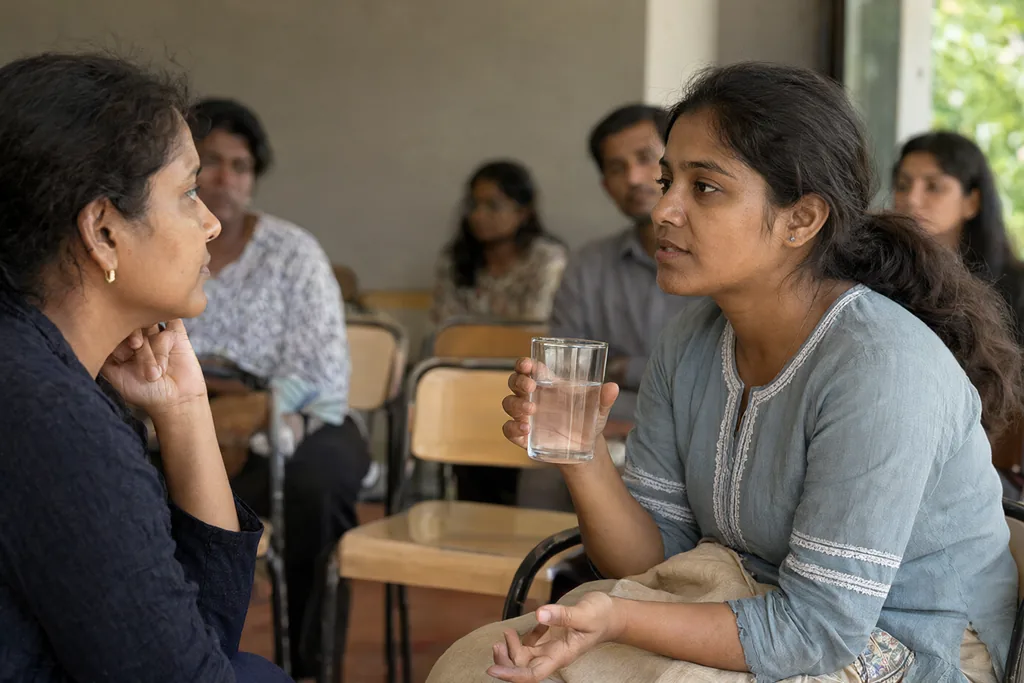
In practice, respect shows up in small choices: how a question is answered, how a mistake is corrected, and whether a learner is given room to try something herself before being rescued.
Safety as a condition, not a feature
Learning requires a certain amount of vulnerability. People only take intellectual risks when they feel safe, which is why safeguarding is treated as a condition of the program rather than an optional extra. Participants must be able to raise a concern without fear of being dismissed or blamed.
Safety also covers information. Details shared in a session or a mentoring conversation stay there, and nothing about a participant is published without her permission.
Inclusion in practice
Inclusion is easy to admire in principle and difficult to deliver in daily work. Barriers to participation are usually practical: cost, distance, timing, confidence or the expectation that a woman's time belongs to others first. Naming those barriers is the first step towards reducing them.
- Cost: ask about what the program provides before assuming you cannot afford it.
- Distance: some sessions can be attended remotely when travel is not possible.
- Timing: tell the team when your availability is restricted.
- Confidence: no question is too basic, and no pace is too slow to be respected.
- Circumstances: a break from study does not end your place in the program.
Honesty about limits
Honesty is a value that sometimes costs the program something. We would rather describe a pathway as uncertain than dress it up as a certainty, and we would rather say that a resource is not currently available than imply that it is. Participants make better decisions when they know the real situation.
The same honesty applies inside the program. If a session did not work, we want to hear about it, because a complaint that is heard early is usually cheaper to fix than a quiet departure.
How the values decide real questions
Values become useful when they settle disagreements. The table below shows how a general principle translates into a specific decision.
| Situation | Value applied | Decision |
|---|---|---|
| A learner is far behind | Respect | Adjust the pace, not the person |
| A concern is raised | Safety | Listen privately and review promptly |
| A cost appears | Inclusion | Look for an alternative before losing the learner |
| A claim is tempting | Honesty | Publish only what can be verified |
| A participant wants to pause | Respect | Keep her place open for return |
Where the participant stands
In every one of these principles, the participant is treated as the decision-maker. The program advises, teaches and supports, but it does not decide on a woman's behalf what she should study or how she should live. That position follows directly from the values above, and it is the reason the program measures itself by what participants go on to do rather than by how many of them stay.
When values are tested
Every value is easy to hold until it becomes inconvenient, and the real test of these principles is what happens when a session goes badly or a participant disappears without explanation. Those moments reveal whether the program means what it says.
When a learner stops attending, the first assumption is not that she was not serious. It is that something practical got in the way, and the team tries to find out what. Sometimes the answer is a clash of timings, sometimes a family responsibility, and sometimes simple discouragement that a short conversation can address.
When a session does not work, the response is to ask the participants rather than to defend the plan. A program that cannot hear criticism will slowly lose the people it was built for, and no amount of good intention compensates for that.
Values are the part of a program you notice most clearly when they are absent. By writing them down and using them to make real decisions, we try to make sure that respect, safety, inclusion and honesty are things a participant can actually feel, not just words on a page.
Read next
About the Sister2Sister Exchange Program
Who we are, why the program exists and what it offers to women and girls.
Our mission: educating the next generation of women leaders
Education first, digital literacy second, independence as the outcome.
How the program works, step by step
From first enquiry to mentoring and study support, explained simply.